Neglected commercial guttering causes serious building damage. Learn why high-level maintenance matters and how GLRE can help. Book a survey today.
Back To Blog.jpg)
Neglected commercial guttering is one of the most consistent causes of preventable building damage in the UK. When gutters block, fail at joints, or detach from the fascia, rainwater that should be directed safely away from the structure instead saturates the building fabric, tracking down facades, penetrating sealant lines, and eventually finding its way inside. For facilities managers and building owners responsible for the UK's commercial stock, a structured high-level guttering maintenance programme is not optional maintenance; it is the most cost-effective way to protect the building envelope and avoid disproportionate repair bills.
Commercial guttering refers to the rainwater drainage systems fitted to commercial, industrial, retail, healthcare, education, and public sector buildings. These systems typically differ from domestic installations in scale, material specification, and the complexity of the drainage layout.
Commercial gutters are often larger in profile to handle the greater roof surface areas they serve. They may run at height across multi-storey facades, include internal box gutters concealed within roof structures, and connect to complex downpipe networks serving large floor areas. The consequence of failure is correspondingly greater: a blocked or failed gutter on a large commercial building can discharge significant volumes of water directly against the facade or into roof build-ups, causing damage that extends well beyond the gutter itself.
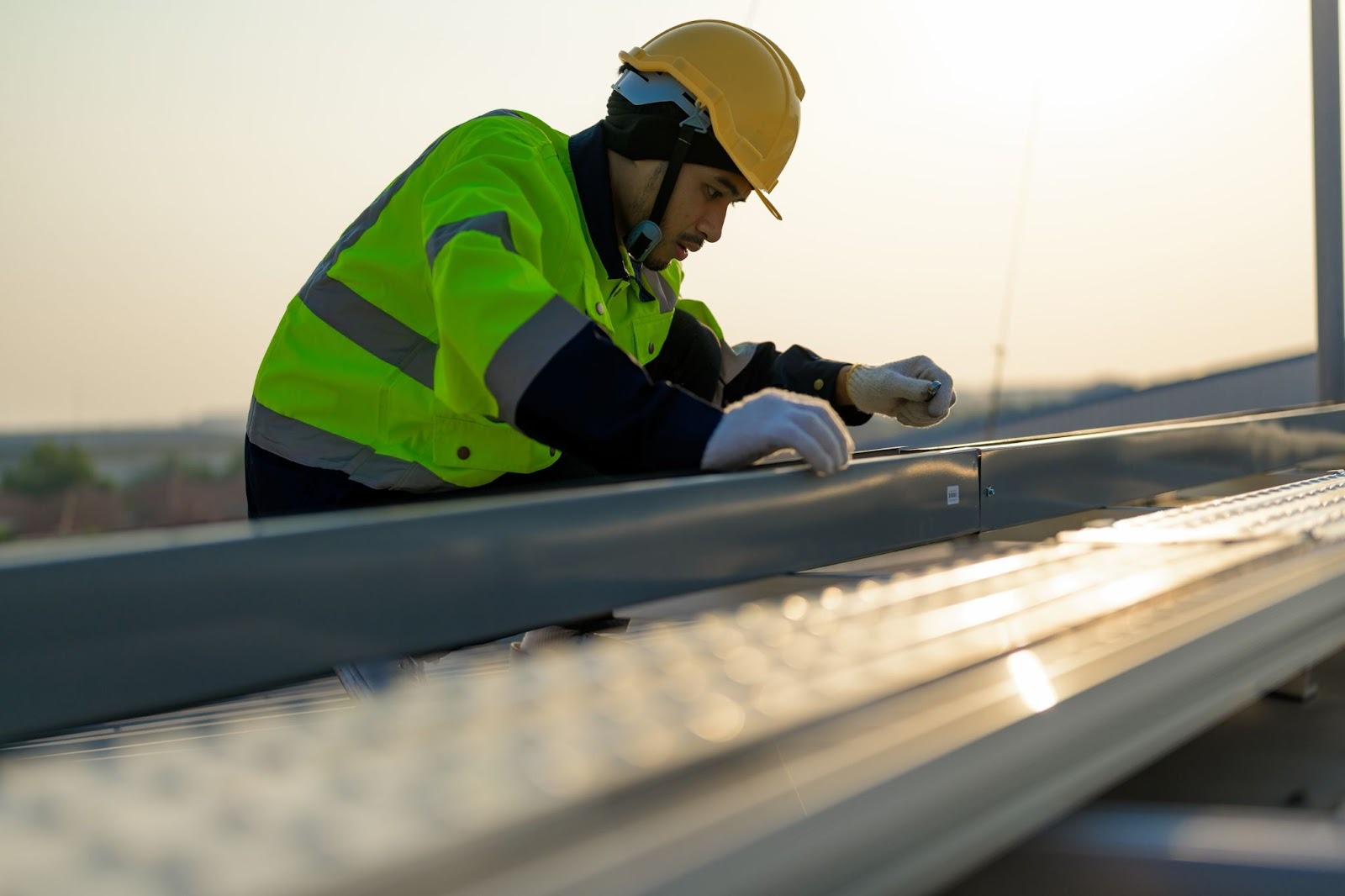
Accessing and maintaining commercial guttering safely and effectively requires specialist equipment and, in many cases, rope access capability to reach the system without scaffolding.
The consequences of inadequate commercial guttering maintenance extend far beyond a wet exterior wall. Water finding its way into the building fabric creates a chain of deterioration that becomes progressively more expensive to address the longer it is left.
In buildings with curtain wall glazing or panel cladding systems, water running unchecked down the facade accelerates sealant breakdown at joints and gaskets. This creates secondary water ingress pathways that compound the original drainage failure. In buildings where cladding refurbishment is already being considered, unresolved guttering issues will undermine any refurbishment work carried out.
The appropriate maintenance frequency depends on the building's location, the surrounding environment, and the design of the guttering system. However, the following general guidance applies to most commercial properties:
A documented maintenance schedule, with records of each visit and any works carried out, also supports compliance obligations under the Health and Safety at Work Act 1974 and provides evidence of proactive management in the event of a dispute or insurance claim.
A professional commercial guttering maintenance visit goes beyond simply removing visible blockages. A thorough programme covers the following:
The entire guttering system is inspected at close quarters, including gutter profiles, joints, brackets, fixings, downpipes, and outlets. The inspection identifies not only current blockages but early signs of joint failure, corrosion, cracking, or movement that will cause problems if left unaddressed.
All accumulated debris, including leaf matter, moss, silt, and any bird nesting material, is cleared from gutters and downpipes. Outlets and hoppers are checked and cleared. Where downpipes are blocked, they are rodded or flushed to restore free flow.
Loose brackets, failed sealant at joints, and minor cracks can typically be addressed during the same visit, preventing small defects from developing into larger failures. Any items requiring more significant remedial work are documented and reported.
A written report of the condition of the system, the works carried out, and any recommended further action provides the building owner or facilities manager with a clear record. This record is valuable for planned maintenance budgeting and supports dilapidations management for leasehold properties.
Safe access is the central challenge of commercial guttering maintenance on multi-storey or complex buildings. The options available are scaffolding, mobile elevated work platforms (MEWPs), and rope access.
For the majority of commercial guttering maintenance programmes, rope access offers the most practical and cost-effective solution, particularly for occupied buildings where minimising disruption is a priority. GLRE's rope access teams are IRATA-qualified and carry full public liability and employer's liability insurance, operating in compliance with Work at Height Regulations 2005.
Once a rope access team is mobilised to a building for guttering maintenance, it is highly cost-effective to combine other high-level inspections and maintenance tasks in the same programme. This avoids the cost of repeated mobilisation and makes the most of the access already in place.
Works that are routinely combined with commercial guttering maintenance include:
Combining works in this way is standard practice for proactive building managers and represents the most efficient use of both budget and access time.
All commercial buildings with external guttering are at risk if maintenance is not kept up to date, but some building types and configurations carry a higher risk profile:
Building insurers expect that a commercial property will be maintained to a reasonable standard. Failure to maintain guttering, particularly where repeated water ingress claims result from the same underlying cause, can affect the outcome of insurance claims. In some cases, insurers may cite lack of maintenance as grounds to reduce or decline a claim for water damage.
A documented maintenance programme, with records of inspections and works carried out, demonstrates that the building owner or facilities manager has met their duty of care. This documentation is also relevant to the management of dilapidations obligations under commercial leases, where tenants are typically required to maintain the building in good repair throughout the lease term.
Yes. Rope access methods are particularly well suited to occupied buildings. Works can be planned and phased to avoid sensitive areas of the building and minimise disruption to occupants. GLRE regularly carries out high-level guttering and maintenance programmes on fully operational commercial, healthcare, retail, and education premises.
Visible signs from ground level include water overflowing from gutters during rainfall, staining on the facade below gutter lines, sagging or visibly misaligned gutter sections, vegetation growing from gutters, and water marks on internal walls or ceilings near the building perimeter. However, not all failures are visible without close inspection, which is why a scheduled inspection programme is more reliable than waiting for visible symptoms.
Commercial guttering systems are sized to match the roof area they drain and the rainfall intensity expected in the building's location. Specification is governed by BS EN 12056-3, which sets out the hydraulic design criteria for rainwater drainage systems. For existing buildings where the system may be undersized or has been extended over time, a drainage survey can confirm whether the current system is adequate for the building's drainage needs.
Yes, when carried out by trained and certificated operatives. GLRE's rope access teams hold IRATA (Industrial Rope Access Trade Association) certification and operate under full method statements and risk assessments in compliance with the Work at Height Regulations 2005 and BS 7985. Rope access is a recognised and regulated method of working at height across multiple industries and is routinely specified for commercial building maintenance.
If your commercial building is overdue a guttering inspection or you need a high-level maintenance programme put in place, GLRE's specialist teams are ready to help. Contact GLRE to book a site survey and receive a tailored maintenance proposal.

Refurb House,
11 Minton Enterprise Park,
Oaks Drive,
Newmarket,
CB8 7YY


.webp)